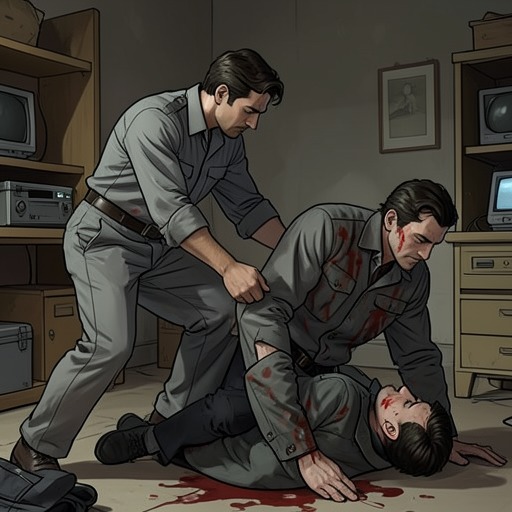
Torquil’s death and Bohdan’s killing
The Zone of InterestTorquil’s death and Bohdan’s killing are joined in Angelus Thomsen’s attempt to reconstruct what happened behind the official story of Paul Doll’s bruised face. Bohdan’s final morning is pieced together from Dov Cohn’s eyewitness account and Thomsen’s deductions: after helping a visibly weakened Doll, Bohdan becomes a prisoner whose knowledge of the Commandant’s vulnerability cannot safely be allowed to circulate. Thomsen can infer the machinery of his killing, but Torquil’s fate remains a separate, unanswered mystery.
The story behind Doll’s bruises
Thomsen’s reconstruction begins with an earlier confrontation between Doll and Hannah Doll. He concludes that she struck her husband during a serious quarrel. As the bruising darkened over the course of the day, Doll needed an explanation for his disfigurement. In Thomsen’s account, Bohdan then attracted Doll’s attention, perhaps accidentally; Doll invented a story about a shovel and passed instructions to Lagerführer Wolfram Prufer, whose adjutant notified the Punishment Commando. Thomsen presents this as the likeliest sequence, not as a complete eyewitness record. Its force lies in the contrast between the injury’s actual source and the convenient account used to direct violence onto a prisoner.
Hannah eventually overturns the public version. Thomsen tells her the account he has received from Boris Eltz: the garden-tool mishap, the order to Prufer, and the dispatch of the Punishment Commando. He omits the gas, yet understands that Hannah knows what has been left unsaid. When she is asked whether Bohdan gave Doll his black eyes, she answers that she did. Her admission reveals how the cover story converts a private act of resistance within the marriage into a pretext for punishing someone outside it.
The official explanation depends on keeping the reversal hidden. Thomsen explains that the story cannot be allowed to circulate because it would mean that a prisoner had struck the Commandant and lived. Hannah’s question about what Bohdan supposedly did brings the contradiction into focus: the charge concerns an assault that did not give Doll his bruises, while the truth would expose both Doll’s vulnerability and the camp’s need to conceal it. The danger attributed to Bohdan is therefore not simply what he may have done, but what his survival after such an act would imply about the Commandant’s authority.
Bohdan’s last morning
Dov’s testimony supplies the scene that Thomsen could not observe. Bohdan had walked from the Stammlager to say goodbye and warn Dov not to look for him at the villa. He then returned, apparently expecting that the authorities would come for him. Dov knew this because Bohdan had told him; the warning makes the visit a farewell as well as an attempt to protect the younger prisoner from searching for him.
On the morning in question, Bohdan went to the Ka Be to have the dressing on his infected knee changed and arrived at the villa garden later than usual, around half past nine. He was in the conservatory when Doll came unsteadily through the glass doors from the breakfast room. Doll wore pyjamas and had one hand pressed to his face. Bohdan initially mistook him for a new prisoner, a Zugang: his clothes were still clean and his stomach still fat, but he seemed drunk, mad, or disoriented. The misrecognition momentarily places the Commandant in the position of a bewildered arrival rather than the unquestioned master of the villa.
Dov then describes Doll seeing a tortoise crossing the lawn, taking up a shovel, and striking its shell with the flat blade. Doll fell backward onto the gravel; his loose pyjama bottoms tripped him. Bohdan did not exploit the scene or abandon him. He went out, helped him up, seated him in the shade, and fetched water. Doll waved him away. That brief assistance, given to a man who had just displayed uncontrolled violence, becomes the last concrete act between them that Dov can report.
A witness to weakness
Dov identifies the reason Bohdan believed the authorities would come: Bohdan had been present when Doll showed weakness and had seen the Commandant cry. The detail changes the meaning of the garden encounter. Bohdan’s danger does not rest on a proven attack; the reconstructed sequence suggests that the shovel story was invented. Instead, he has witnessed a moment that Doll cannot permit to become common knowledge. The account makes visibility itself perilous: seeing the man behind the office and uniform is enough to place a prisoner at risk.
Bohdan’s connection with Dov gives the farewell further weight. Dov, a fifteen-year-old German Jew, had been Bohdan’s Pikkolo, a term Hannah used for a young companion or charge whom an older prisoner looked after. The two were described as very close, and Dov had sometimes been seen in the Dolls’ garden. Thomsen locates him in Block 4(vi) of Kat Zet III, a camp still under construction and then occupied by builders. When Thomsen questions him, Dov’s knowledge is not abstract: it includes Bohdan’s warning, his expectation of arrest, and the kindness he showed Doll immediately before he disappeared into the camp’s punitive apparatus.
Thomsen’s own conduct underscores the limits and risks of testimony. After speaking with Dov, he gives him the remaining cigarettes and ten US dollars, telling him to put them somewhere safe. The exchange does not undo what has happened to Bohdan; it is a small, practical response to a witness who knows more than is safe to say. Elsewhere, Thomsen’s reconstruction leaves one question open: he identifies the fate of Torquil as the only remaining mystery, but supplies no account of what happened to him. The two deaths are therefore linked by the investigation, not by an established shared circumstance.
Violence, concealment, and the camp
The killing belongs to a wider system in which violence is made to appear administrative, disciplinary, or necessary. Earlier, Doll declares that he will not tolerate pampering, affirming punishment rather than care as the governing principle. At Spring Meadow, he describes himself as a normal man with normal feelings, then justifies cruelty by setting the supposed good of Germany against kindness to a Jew. These claims illuminate the gap between his self-image and the violence enacted under his authority; they do not excuse or explain away Bohdan’s killing.
Doll’s treatment of Der Stürmer also exposes the selective character of his ideological objections. He says that the publication’s lurid sexual caricatures damage antisemitism’s cause, preferring charts, statistics, and purported scientific evidence. His objection is not to antisemitism but to a form of propaganda he considers counterproductive. That preference for a supposedly rational presentation of persecution sits beside the invented account of Bohdan’s offense: ideological language and administrative procedure furnish ways to conceal violence while presenting it as purposeful.
Later, on November 9, Doll’s disoriented questions turn back toward the conditions of the camp: its stench, the drunkenness, the churning meadow, and the snow turned brown. He asks why the work is so foul if it is good, but does not thereby repair the truth he helped suppress. Against his earlier insistence that deeds should be judged only by their outcomes, the remembered particulars of Bohdan’s last morning restore the human scale he tries to erase: an infected knee, an expected farewell, a tortoise struck with a shovel, water fetched for a fallen man, and a witness left behind. Torquil’s fate remains unknown; Bohdan’s story, by contrast, is recovered only in fragments, and those fragments expose the lie that made his killing possible.